Virtual Presentation Skills | Zoom Meetings, Work Remotely, Design An Online Office, Enhance Your 2D Image
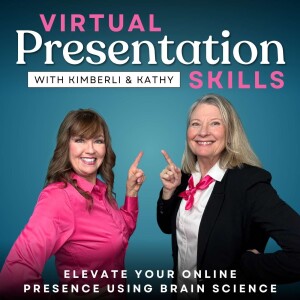
🩷 The Go-To-Podcast for Virtual Presentation Skills
🩷 Our mission is to help humans minimize virtual communication frustration, make money and thrive in the hybrid world.
🩷 Whether you are speaking in a meeting or presenting, we empower you to communicate with confidence and impact.
Listen on:










Episodes
16 hours ago
16 hours ago
*Discover the science behind virtual presence—and how confident leaders earn trust fast online using voice, visuals, and clear messaging.
What “presence” really is (and why it wins online)
Presence isn’t about being the loudest, funniest, or most “polished.” It’s the felt sense of certainty and safety people experience when you speak—especially on camera. In virtual settings, your audience has fewer signals to interpret, so they rely heavily on confidence cues: clarity, steadiness, and congruence between what you say and how you show up.
In this episode, we break down the psychology and behavioral science behind why people follow confident leaders online—and how you can build that kind of trust without becoming someone you’re not.
You’ll learn
Why your audience makes snap judgments online (and how to guide those judgments ethically)
The confidence signals your brain looks for before it “follows” someone
How camera presence and vocal presence create credibility faster than content alone
The fastest way to sound more authoritative (without sounding aggressive)
A simple “presence protocol” you can use before every call, live, or webinar
The science behind “people follow confident leaders”
1) Confidence reduces cognitive load
When you communicate with structure and certainty, your audience expends less mental energy trying to decode you—so they can actually absorb your message.
Try this: Lead with a one-sentence point-of-view:
“Here’s what matters most about this…”
2) Humans are wired for emotional calibration
People unconsciously “sync” to the emotional tone in the room—even online. If you’re scattered, rushed, or apologetic, your audience feels it. If you’re grounded, they relax.
Try this: Slow your first 10 seconds by ~15%. It reads as confidence, not boredom.
3) Presence is built through congruence
The biggest killer of credibility isn’t a bad webcam—it’s mismatch: confident words with uncertain delivery (or vice versa). Presence grows when your message + tone + pace + facial energy align.
Try this: Say fewer things, but say them cleaner.
The 3-part Presence Protocol (use this before every meeting)
Step 1: Stabilize
Feet grounded, shoulders down
One full inhale + slow exhale
Decide your “one outcome” for the conversation
Step 2: Signal
Look at the lens (not the screen) when stating key points
Use a slower pace + clean pauses
Speak in complete sentences (avoid trailing off)
Step 3: Serve
Make it easy to follow you: clear structure, clear next steps
Repeat the “headline” in a new way at the end
Invite action with confidence, not apology
Quick Virtual Presence Audit (save this)
Use this checklist before you go live on Zoom / Microsoft Teams:
Visual presence
Camera at eye level (or slightly above)
Face well-lit from the front (not overhead)
Background clean and intentional
Frame: head + upper chest (don’t be a floating head)
Vocal presence
End sentences downward (avoid accidental “question voice”)
Pause after your key line
Reduce filler words by replacing them with silence
Message presence
Start with: “Today, we’re solving ___.”
Use 2–3 sections max (not 9 “quick things”)
End with: “Here’s the next step.”
Key takeaways
Online followership is often driven by felt certainty, not just expertise.
Confidence is communicated more through clarity + pace + structure than volume or hype.
Presence is learnable: it’s a system of signals you can practice and repeat.
The goal isn’t performance—it’s trust.
Listener challenge (5 minutes)
Before your next call:
Write your one-sentence headline.
Deliver it once looking at the camera lens.
Repeat it with a slower pace and a pause at the end.Pick the version that feels calmer and clearer—then use that as your default.
Ideal for
Leaders, coaches, entrepreneurs, managers, and speakers who want to:
lead meetings with authority
build trust on LinkedIn and YouTube
feel confident on camera without becoming “salesy”
improve executive presence in virtual communication
Virtual Office Audit
happiness@virtualofficeaudit.com
7 days ago
7 days ago
Episode 90 of the Virtual Presentation Skills Podcast announces a co-host transition and the future of the show, with insights on podcasting, presentation fitness, and virtual presence.
Ninety episodes is no small achievement. In this Minicast Mastery milestone, the Virtual Presentation Skills Podcast marks a transition as co-host Kathy Gadinas shares her final episode. Together, Kathy and Kimberli reflect on what it took to build the podcast from the ground up and how recognizing the right moment to step away can be a powerful professional decision.
The conversation explores presentation fitness, confidence on camera, and the practical skills gained from producing and hosting a global podcast. Kimberli also explains why virtual presence and environment play a critical role in audience engagement, credibility, and long-term business success.
As the show moves into its next chapter as a single-host, guest-driven podcast, this episode celebrates growth, learning, and evolution—on and off the screen.
Ready to elevate your virtual presence? Start with the Group Virtual Office Audit—30 minutes, 7 steps, under $100. Learn more at 🔗Virtual Office Audit
We appreciate all the “LIKES” from our listeners. Please feel free to like and comment again if this episode fires you up!
Contact us at:
Happiness@virtualofficeaudit.com
🔗Kimberli Gilbert Linked In
Tuesday Jan 27, 2026
Tuesday Jan 27, 2026
Learn how Presentation Fitness shapes your energy, confidence, and impact on screen. In Episode 89, Tanis Morris shares grounding strategies, mindfulness, and Feng Shui principles to help leaders thrive in virtual environments.
We explore Presentation Fitness—the foundation of showing up energized, focused, and confident in virtual meetings.
Our guest, Tanis Morris, Co-Founder and CEO of Fin Source Global, shares how grounding the body and mind supports leadership presence in a 2D world. We discuss practical ways to manage virtual fatigue, design intentional workspaces, and use Feng Shui and the Bagua Map to create environments that support clarity, flow, and performance.
This episode blends leadership, mindfulness, and modern virtual presence for professionals working anywhere.
You’ll Learn:
What Presentation Fitness means for virtual leaders
How grounding improves energy and on-screen presence
Why your virtual workspace affects confidence and focus
Simple Feng Shui concepts for modern offices
🎯 Optimize your virtual presence with the Group Virtual Office Audit — 30 minutes, 7 steps, real results.👉 🔗Virtual Office Audit Registration
We would love to hear your Feng Shui experience! Email us at Happiness@virtualofficeaudit.com
Or reach out to us on LinkedIn.
🔗Kimberli Gilbert Linked-In
🔗Kathy Gadinas Linked-In
Thursday Jan 22, 2026
Thursday Jan 22, 2026
Four tech hacks to boost confidence and credibility when presenting from anywhere. Learn how audio, lighting, camera stability, and backup plans reduce stress and build trust.
Presenting from anywhere shouldn’t mean sacrificing confidence or credibility. In this Minicast Mastery episode of the Virtual Presentation Skills Podcast, we share four simple tech hacks that help remote professionals and digital nomads stay calm, clear, and professional—no matter the location.
Because when tech fails, your nervous system reacts—and your audience notices.
In this episode, you’ll learn how to:
Prioritize clear audio to instantly boost trust
Use portable lighting to improve facial clarity and engagement
Create camera stability that reduces cognitive fatigue
Build a backup plan that lowers stress and increases resilience
It’s not about perfect tech—it’s about designed presence.
Book your Group Virtual Office Audit at 🔗 Virtual Office Audit Registration for a 30-minute, 7-step audit to ensure your virtual setup supports confidence and credibility.
Recommended travel products that work for us are listed below. We are an Amazon Affiliate and may make a small commission on products sold.
🔗Samson Meteor Microphone
🔗GEAR portable ring light
We would love to hear from you. Please email happiness@virtualofficeaudit.com for questions. Or, reach out to us on LinkedIn
🔗Kimberli Gilbert Linked-In
🔗Kathy Gadinas Linked-In
Tuesday Jan 20, 2026
Tuesday Jan 20, 2026
Discover how to become a confident “Kitchen Table CEO.” Learn virtual meeting strategies that reduce stress, build credibility, and help you look professional from anywhere you work.
Are you working from your kitchen table, a guest room, or wherever Wi-Fi allows? In this episode of the Virtual Presentation Skills Podcast, we explore the Kitchen Table CEO mindset—and how to look professional, confident, and leadership-ready without a traditional office.
We explain how the brain instantly evaluates credibility, trust, and preparedness in virtual meetings—and why lighting, camera angle, audio, and background matter more than most professionals realize.
Through real-world examples and brain science, you’ll learn how small environmental shifts can reduce cognitive load, increase engagement, and help your audience focus on your message instead of distractions.
In this episode, you’ll learn:
Why your virtual environment directly impacts trust and leadership perception
The most common virtual setup mistakes professionals make
How to reduce distraction and increase engagement on camera
Why professionalism and leadership are now portable skills
Kimberli also shares the Kitchen Table CEO Checklist, a free resource to help you quickly prepare before going live.
Resources Mentioned:
Group Virtual Office Audit - 🔗Group Virtual Office Audit Registration
Free Kitchen Table CEO Checklist: Please email happiness@virtualofficeaudit.com
Contact: happiness@virtualofficeaudit.com to be on our mailing list and/or if you are interested in advanced virtual communication training.
🔗Episode 2 | Virtual Presentation Mistakes that are Costing $100,000
Amazon Affiliate items mentioned: (We may earn a small commission if these products are purchased.)
Gear Ring Light - https://amzn.to/4mVfClV
Shure MV7 Microphone - https://amzn.to/4odqgWh
>> Your leadership isn’t defined by where you work—it’s defined by how intentionally you show up. <<
We would love to hear about your virtual set-up challenges when working from anywhere. You can reach us via email at happiness@virtualofficeaudit.com or on LinkedIn.
🔗Kimberli Gilbert Linked-In
🔗Kathy Gadinas Linked-In
Thursday Jan 15, 2026
Thursday Jan 15, 2026
Brain-friendly tips to keep virtual audiences awake and engaged. Learn how attention rhythms, visual stability, and micro-gestures improve online presentations.
Virtual audiences don’t fade because they’re bored—it’s brain biology. In this Minicast Mastery episode of the Virtual Presentation Skills Podcast, we share simple, brain-friendly ways to keep audiences alert, engaged, and mentally present online.
Learn why attention predictably drops at 7, 12, and 20 minutes, how visual stability supports focus, and why micro-gestures—not high energy—signal engagement on camera. These strategies help you design virtual presentations that work with the brain, not against it.
You’ll learn how to:
Design for attention dips in virtual meetings
Use intentional resets to sustain focus
Create visual stability that keeps the brain engaged
Gesture effectively on camera without distraction
Turn insight into action. Book a Group Virtual Office Audit and start designing a virtual setup that keeps audiences engaged. 🔗Register here for Group Virtual Office Audit Training
Follow, comment, or connect with us on LinkedIn, Facebook and Instagram (VirtualEngage) —we’d love to support you.
Happiness@virtualofficeaudit.com
🔗Kimberli Gilbert Linked-In
🔗Kathy Gadinas Linked-In
Tuesday Jan 13, 2026
Tuesday Jan 13, 2026
What if charisma isn’t a gift—but a skill you can master? Discover how to master charisma with Demet Tuncer, global speaker (World Economic Forum, FIFA World Cup, FIBA World Championships) and leadership strategist. Learn the Five Banks + Master Key to engage any audience. Demet, is also known as the Queen of Charisma!
In this powerful episode of the Virtual Presentation Skills Podcast, we’re joined by Demet Tuncer, globally recognized speaker, charismatic leadership strategist, TEDx speaker, award-winning actress, and the voice behind Disney’s Princess Tiana (Turkish).
Demet reveals how she reverse-engineered 30 years of stage and screen mastery into a repeatable charisma framework leaders can use instantly—on stage, on camera, and in high-stakes virtual meetings.
🔑 What You’ll Learn:
Why charisma is learned, not inherited
Demet’s Charisma Formula: Five Banks + the Master Key
Knowledge (audience awareness)
Character (presence, voice, energy)
Story (data + storytelling)
Humor (connection over perfection)
Vulnerability (authentic leadership)
Master Key: Courage
How posture, voice, and presence impact charisma (on stage or virtually)
Why brilliant leaders often sound boring—and how to fix it
One simple, immediate adjustment to increase authority and engagement
How charisma becomes a leadership strategy, not a “nice to have”
This episode is a must-listen for leaders, speakers, entrepreneurs, and professionals who want to be unforgettable—both in person and online.
🎧 Listen now and start activating your charisma.
Ways to contact Demet Tuncer:
🔗Demet Tuncer's Website
🔗Demet Tuncer on YouTube
🔗Demet Tuncer LinkedIn
🔗Demet Tuncer Instagram
We would love to hear your thoughts about this episode! Please email us at Happiness@virtualofficeaudit.com or connect with us on LinkedIn and/or Instagram (virtualengage).
🔗Kimberli Gilbert LinkedIn
🔗Kathy Gadinas LinkedIn
Remember, to improve on your virtual communication skills, register for the Virtual Office Audit. 30 minutes, 7 steps 🔗Enroll in the Group Virtual Office Audit
Thursday Jan 08, 2026
Thursday Jan 08, 2026
How do leaders build trust fast in virtual meetings? This Minicast Mastery breaks down six leadership habits that improve credibility, clarity, and follow-through on Zoom and beyond.
In this Minicast Mastery episode of the Virtual Presentation Skills Podcast, we explore how leaders can build trust quickly in virtual and hybrid environments by shifting from personality-driven leadership to intentional, repeatable habits.
Rather than relying on charisma or constant availability, this episode focuses on what teams actually experience on screen—from consistency and camera presence to meeting structure and follow-through. In less than 10 minutes, you’ll walk away with practical behaviors you can apply immediately in meetings, presentations, and daily leadership moments.
In this episode, you’ll learn how to:
Reframe trust for the virtual workplace
Be predictable before trying to be polished on camera
Use your camera setup to signal credibility and attention
Start meetings with clarity instead of small talk
Acknowledge people before advising them to strengthen psychological safety
Close the loop consistently to prevent trust erosion
This Minicast reinforces why trust is built through habits, not personality traits, and why these skills are observable, coachable, and measurable, through the Virtual Office Audit. 🔗Virtual Office Audit Training Dates
To learn more about our training programs, click on 🔗Everything Webinar Training Programs and go to the Services Offered Tab
If you have any questions or are interested in additional training, please email us at Happiness@virtualofficeaudit.com
Connect with us on LinkedIn, Instagram (virtualengage) and Facebook
🔗Kimberli Gilbert Linked-In
🔗Kathy Gadinas Linked-In
Tuesday Jan 06, 2026
Tuesday Jan 06, 2026
Camera confidence is a leadership skill. In Episode 83, learn the neuroscience behind trust, authority, and how great leaders show up on screen.
Welcome to 2026 and a new season of the Virtual Presentation Skills Podcast. In Episode 83, we launch the Virtual Leadership pillar by reframing camera confidence as a core leadership skill—not a personality trait.
Great leaders don’t perform on camera—they create trust. This episode breaks down the neuroscience behind first impressions, authority, and credibility on screen, and explains why your audience decides whether to trust you within milliseconds.
You’ll learn how virtual environments increase cognitive load, why visual and audio clarity often outweigh content, and how intentional design choices reduce friction for your audience’s brain.
In this episode:
Why camera confidence is driven by neuroscience, not charisma
How trust and authority are formed on screen in milliseconds
Why experienced leaders often struggle in virtual settings
The impact of background, lighting, posture, and camera height
Five ways to intentionally design camera confidence
How the Virtual Office Audit builds confidence in 30 minutes, step by step
We also discuss confidence as a learned skill built through education and practice, and why virtual leadership training is no longer optional.
Resources:
Virtual Office Audit – 30 minutes, 7 steps to stronger virtual presence 🔗Group Virtual Office Audit
Related episode: E57 | Commanding the Room (Without a Room): Your Virtual Leadership Secrets 🔗Ep 57 | Commanding the Room (Without a Room): Your Virtual Leadership Secrets
Interested in more information about coaching? Email us at Happiness@virtualofficeaudit.com
Special announcement:
Kathy Gadinas shares she’ll be stepping away from the podcast in the coming weeks. While the show will continue with Kimberli and expert guests, this episode marks the beginning of a meaningful transition – and a celebration of what’s been built together.
If you lead teams, facilitate meetings, consult, or aspire to leadership, this episode will change how you think about showing up on camera.
🎧 Join us next time as we continue helping leaders go live from the waist up.
Please connect with us on LinkedIn, Instagram (Virtualengage) and Facebook
🔗Kimberli Gilbert Linked-In
🔗Kathy Gadinas Linked-In
Thursday Jan 01, 2026
Thursday Jan 01, 2026
Virtual Greetings in 2026 examines how AI, deepfakes, and digital authenticity are changing trust, leadership presence, and virtual communication.
As 2026 begins, virtual presenters face a new reality: audiences may no longer know if they’re interacting with a human or AI. In this Minicast Mastery episode, we explore how artificial intelligence, deepfakes, and digital twins are reshaping trust, credibility, and presence in virtual communication.
Drawing on brain science and real-world presentation strategy, this episode explains why humans instinctively detect authenticity through voice, eye contact, micro expressions, and movement—and why those cues matter more as AI-generated content becomes harder to spot. You’ll also learn how balanced on-camera presence reduces cognitive load, increases trust, and strengthens professional reputation in both virtual and in-person settings.
If you want to lead meetings, present confidently, and communicate with clarity in an AI-influenced world, this episode offers practical insight you can apply immediately.
Topics include:
AI and deepfakes in virtual meetings
Authenticity, trust, and leadership presence
Brain science behind credibility on screen
Why symmetry and predictability signal safety
Strengthen your on-camera presence with the Virtual Office Audit, a 30-minute, seven-step training that improves lighting, sound, voice, and visual engagement for virtual and in-person presentations. 🔗Virtual Office Audit Registration
Looking forward to hearing from you in 2026. Please continue to email suggestions and/or questions to happiness@virtualofficeaudit.com.
We are also on Linked-In, Instagram (VirtualEngage) and Facebook
🔗Kimberli Gilbert Linked-In
🔗Kathy Gadinas Linked-In